Monday, July 14, 2008

Rotadent Vs Sonicare Reviews

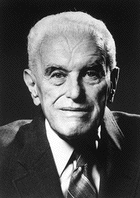
JOHN C.HARSANYI


NOBEL PRIZE 1994
BIO
THEORY


Economist specialist utilitarianism


"For his pioneering work in the field of analysis of equilibrium in the theory of non-cooperative games "
(with John Forbes Nash and Reinhard Selten)


He developed a utilitarian approach to public policy. In the tradition of J. Bentham and Paul Samuelson, Harsanyi established a social welfare function from which it attempts to define the criterion of income distribution that would be adopted by individuals rational and impartial. Originally

Hungarian pharmacist until after the end of the war, he taught psychology at the university until 1948. He left Hungary illegally and joined Australia where he became a laborer. He resumed his studies and chose for the economy etdonne economics courses at the University of Queensland in Brisbane. He left for Stanford University in 1956 where he earned a Ph.D. in Economics under the direction of Arrow. He is a professor in Canberra then Detroit and finally to Berkeley.

He quickly became an expert in game theory and methodology brings to this theory, the tools that he lacked lyc arsonval brive.ac limoges

"veil of ignorance" by John Harsanyi.
Individuals responsible for developing principles of justice are unaware of what their future situation. Will they be poor or rich, when they are young or old, they will be favored as a man or woman, etc.. So the choice of principles should not be linked to the knowledge of their future place in society once the veil of ignorance is lifted. Yet, even if they are still behind the veil of ignorance, they are no less calculating and selfish. As the basis of their calculation excludes any knowledge of probabilities, it is prudence that guides their choice in the adoption of these principles. They minimize the risk to the extent that they are likely to be in the position less fortunate. Auxiliary assumptions are needed. Among these, there is the idea of a society of "moderate scarcity" in which poor people can get something better than the rich do not make great sacrifices. This assumption of moderate scarcity is important in the lexical order of the two principles of justice. In fact you have to imagine two more symmetrical situations: one that accepts the risk of being very poor with the opportunity to become very rich through the principle of freedom and conversely those who prefer to sacrifice freedom in exchange for poverty limited. To answer this question, Rawls admits that the marginal utility of material gain decreases fast enough when prosperity increases. In Theory of Justice, maximize the minimum of the most disadvantaged individuals named maximin. This is coupled with another principle, that of leximin. Not since the social hierarchy, individual by individual, trying to maximize the minimum of everyone at every level of the hierarchy. its ac bordeaux

Best Currency Invest 2010

FRANZ BOAS


SITE
AMNH
BIO
HUMANITIES
TEXT
INUIT
REVIEW Potlatch


pioneer in the field of ethnology

Boas, Franz, anthropologist, ethnologist, folklorist and linguist (Minden, Westphalia, 9 July. 1858 - New York, December 21, 1942). In collaboration with his students, Boas defines the intellectual and professional orientation of American anthropology. It stresses the need to address the study of the history of cultures using an empirical method. His work highlights the historical factors that combine and blend to give each company its distinctive character. Boas
primarily interested in historical geography, but the pioneering work he performs in INUIT OF BAFFIN ISLAND (1883-1884) led him to conclude that the customs of a people do not only geography and often develop against environmental constraints. From 1886 he focused his research definitive Coast Indians Northwest. The richness of their art and their mythology more convinced of the need to consider the psychological characteristics as well as geographical data in his research. These characteristics are developed over the centuries by borrowing traits from other cultures, modifying and integrating them a new culture.

His many students are the greatest legacy of Boas. The brightest of them, Edward Sapir, was the first director of what is now the CANADIAN MUSEUM OF CIVILIZATION. For many years, Boas dominated American anthropology and is a mentor to most of the first women working in this occupation, including Ruth Benedict and Margaret Mead. He worked tirelessly and effectively to wrest the public's belief in the race and to adopt a scientific conception of culture as a basis to explain the main differences among human groups. RJ PRESTON

It is mainly devoted to the study of American Indians. Formed by the natural sciences, it focuses on observation, on the need for descriptive and empirical basis of research in ethnology. His physical anthropology leads to the radical critique of the concept of race. He rejects the two major schools of his time, evolutionism and diffusionism, and develop a physical and cultural anthropology (psychological research processes unique to each people in language, art, myth and religion) who also claims the importance of individual experiences to the study and understanding of peoples. His thoughts profoundly influenced American anthropology of the early nineteenth century. encarta


"If you ask me, a gun to his head, what was the greatest advancement of anthropology in the last century, I would say without hesitation that it is to have laid bare the fallacy of racist, a discovery that actually goes back to work by Franz Boas in New York in the early twentieth century. Boas showed that there were no mentally irreducible differences between human communities and that, fundamentally We all think the same way. In particular, there is nothing that resembles a primitive thought. The "pansy" has no real existence. We are all primitives. We are all products of evolution also long. The differences between cultures regarding the mental habits are the result of any innate biological determinant or any historical process type. We built our cultural differences, we can get rid of it if we want. "
Felipe Fernandez-Armesto
Professor at the University of London


Boas, will attack front all the racial theories and demonstrate that the very notions of race, climate change, displacement geographical areas may alter the body of men and some innate traits, are innate immemorial. We find it also in the works of Durkheim who shares it the same way.
Both are of Jewish culture. They therefore lived intensively this look, this sense of exclusion that could lay next to their knowledge about their Jewishness, they lived inside. They questioned the scientific basis of race science. ceishs

Brother Mfc-490cw Status Monitor Offline

BRONISLAW GEREMEK


PARLIAMENT
PORTRAIT


He was a key architect of the democratic transformations that precipitated the fall of communism in Eastern Europe.


"After Europe, we Europeans need to do now. Otherwise, we risk losing the"

"We must put things into question, first by posing the problem of history of European civilization. Because I believe, not only as a historian, but also as a European, that the problem of Europe, of European civilization and European identity, the key problem of memory ... "Prof. . Bronislaw Geremek, Chair in European Civilization

" The weakness of democracies in the post-communist societies do not come of what happened before their entry into communism. The fundamental fact was the abolition of the market economy, removal destroys relationships between people. Communism was founded on the passivity of society. Sometimes humanity to engage in blind alleys: Communism was one of them. "Symposium experience of freedom (Mexico 1990)


Bronislaw Geremek, a specialist in medieval history and French Polish politician, died Sunday, July 13, 2008 in a car accident at the age of 76 ans.L a founding member of the Solidarity trade union and a close adviser to Lech Walesa, the historic leader, he had belonged to a small group of intellectuals advocating, as early as 1970, a non-violent opposition to the totalitarian regime imposed on Poland by the Union the Soviet figaro


Geremek, Bronislaw (1932-2008), Polish historian and politician.

A Francophile intellectual

Born in Warsaw, a Jewish intellectual family, Bronislaw Geremek grew up in the Warsaw ghetto. He managed to leave in 1943 with his mother while his older brother survived the deportation to Bergen-Belsen and her father died at Auschwitz.

Back in Warsaw in 1948, Bronislaw Geremek finishes high school. He studied history at university in his hometown and at the École Pratique des Hautes Etudes in Paris, where he stayed several times in 1956, 1957 and 1962, thanks to grants from the French government. First attracted by the contemporary history, he prefers to focus on the history of the Middle Ages, less subject to Marxist dogmatism. 1962, he became head of the Polish Center of civilization that has been created at the Sorbonne. Avid reader of the Annales school, he became interested in the work of Marc Bloch, whom he considers his spiritual master, Fernand Braudel, Lucien Febvre and Henri Pirenne and became a friend of Jacques Le Goff and medievalist Georges Duby.

historian marginality

At a time when the subject meets only indifference historian, Bronislaw Geremek turns to the study of poverty. Fascinated by the history of mentalities, he specializes in social history, that of crime, exclusion and marginality. His thesis on the Outsiders Paris in the fourteenth and fifteenth centuries, sustained in 1972, is published in France in 1976. Thereafter, his principal works disclaim this topic: Truands and poor in modern Europe 1350-1600 (1980), Useless in the world. Vagabonds and marginals in Europe in the fourteenth and fifteenth centuries (1980), Waged in crafts in the fourteenth and fifteenth centuries. Market Study of the workforce Middle Age (1982), the stem or Pity. Europe and the poor of the Middle Ages to the Present (1987) and the Sons of Cain. The Image of the poor and vagabonds in literature from the fifteenth to seventeenth centuries (1991). Lecturer at the University of Warsaw from 1965 to 1980, he served in 1993 as the international chair of the College de France "Social History: exclusions and solidarity." In 2002 he received the Grand Prix de la Francophonie for the whole of his work in French.

Political commitment alongside Solidarity

Player works founders of Marxism from 1948, Bronisław Geremek joined the Polish United Workers' Party (Stern) in 1950. He left after the Soviet intervention against the Prague Spring in 1968. In 1980, he went on strike in the Gdansk shipyards, along with Tadeusz Mazowiecki, to seal the alliance between intellectuals and workers and participates in negotiations that lead to the signing of the Gdansk (August 31, 1980) and the creation of the Solidarity trade union. Bronislaw Geremek became a personal adviser to Lech Walęsła. Following the declaration of a state of war by General Jaruzelski (December 13, 1981), Bronislaw Geremek was imprisoned until December 1982. In 1989, during the negotiations of the Round Table, he is one of the main mediators between the government and Solidarity. Following the June 1989 elections, Bronislaw Geremek, Chair of the Caucus of Solidarity, the Committee to reform the Constitution and Foreign Affairs Committee of the Diet. After his departure from Solidarity in 1990, he joined the Liberties Union (UW).

Foreign Minister of Poland (1997-2000)

After the victory of Solidarity Electoral Action (AWS) in the 1997 parliamentary elections and the formation a center-right coalition between the AWS and UW under the direction of Jerzy Buzek, Bronislaw Geremek became Minister of Foreign Affairs. In this capacity, he chairs the Organization for Security and Cooperation in Europe (OSCE) in 1998 and advocates a rapid accession of Poland to the European Union (EU). The rupture of the coalition AWS / UW in June 2000 means the end of his mandate. He then chaired the Parliamentary Committee for Polish EU law. In December 2000 he was elected president of the UW, but he abandoned this position after the defeat of UW parliamentary elections September 2001 - with 3.3 per 100 votes, the party is below the 5 per clause 100. Following the entry of Poland into the EU in May 2004 he was elected to Parliament and sits on the Alliance of Liberals and Democrats for Europe (ALDE) in the center of the chessboard European policy.

Bronislaw Geremek returns on its route to intellectual committed to fracture. Poland from communism to democracy (1991) and the Historian and Policy (1999).
encarta


Conference on Marc Bloch B. Geremek
This article is the text of the conference would have to pronounce the Polish historian Bronislaw Geremek, a medievalist at the conference Marc Bloch in 1986, who closed the conference dedicated to 100th anniversary of the birth of Marc Bloch. In the absence of its author, stopped by the Polish situation to go to Paris, Jacques Le Goff, who read the text. Bronislaw Geremek was adviser to Lech Walesa and Foreign Minister of Poland (1997-2000).